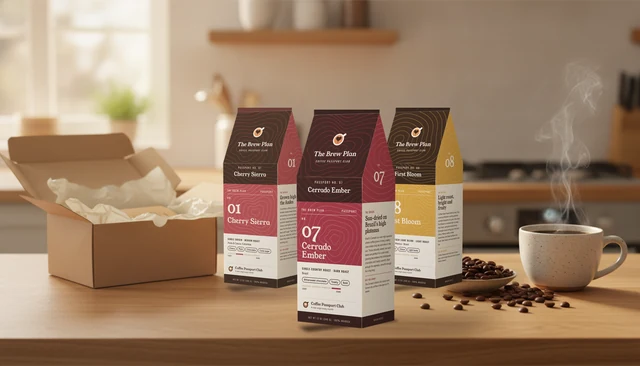
Every coffee bean starts out green, hard and grassy. Roasting turns it brown, and how long it stays in the heat decides most of what you taste. Stop early and you get a light roast. Keep going and you get a dark roast. Neither is better. They're different drinks, and the right one depends on what you like and how you brew.
The short version
- Light roast tastes bright, fruity and a little tea-like. You taste the bean and where it grew.
- Medium roast is balanced and sweet, with caramel, nut and milk chocolate notes.
- Dark roast tastes bold, smoky and bittersweet, with a heavy body. You taste the roast.
- Caffeine is about the same in all three.
- "Strong" comes from your recipe, not from the color of the bean.
What roasting does to a coffee bean
In the roaster, beans dry out, turn from green to yellow to brown and puff up. Their natural sugars brown, much like toast or caramel. At around 385°F (196°C) the beans make a popping sound that roasters call first crack. Light roasts are stopped soon after it.
Leave the beans in and they keep darkening. The fruity, tangy flavors fade and deeper caramel and cocoa flavors build. Near 435°F (224°C) there's a quieter second crack, oils start to move to the surface, and the taste of the roast itself takes over. That's dark roast territory.
Along the way the beans lose water and weight and grow in size. A dark roasted bean is bigger, lighter and more brittle than a light roasted one. That matters when you measure coffee, as you'll see in the caffeine part below.
Light vs medium vs dark roast at a glance
| Light | Medium | Dark | |
|---|---|---|---|
| Bean color | Light brown, dry surface | Medium brown, mostly dry | Dark brown to nearly black, often shiny with oil |
| Taste | Bright, fruity, floral, citrus | Caramel, nuts, milk chocolate | Dark chocolate, smoke, toasted, bittersweet |
| Acidity (brightness) | High | Medium | Low |
| Body | Light, tea-like | Rounded | Heavy |
| Bitterness | Low | Medium | Higher |
| What you taste most | The bean and its origin | A bit of both | The roast |
| Names you may see on bags | Light, cinnamon, light city | City, breakfast, American | Full city (medium-dark), Vienna, French, Italian |
These names aren't regulated, so one roaster's medium can be another's dark. If the bag has tasting notes, trust those more than the roast name. "Berry, citrus, floral" points to a lighter roast. "Cocoa, toasted nut, smoky" points to a darker one.
Which roast has more caffeine?
They're closer than most people think. Caffeine holds up well in the roaster, so a single light roasted bean and a single dark roasted bean have about the same amount.
The small difference comes from how you measure:
- By the scoop: light roast beans are smaller and denser, so more coffee fits in the scoop. A scoop of light roast has slightly more caffeine.
- By weight: it evens out. Twenty grams of dark roast is a few more beans than twenty grams of light roast, so the caffeine is nearly equal.
Either way the gap is small. How much coffee you use, the size of your cup and the type of bean change your caffeine far more than roast level does. Our caffeine calculator gives a rough estimate for your day.
This is general information, not medical advice. Caffeine affects people differently. If you're pregnant, nursing, sensitive to caffeine or have a health condition, check with your doctor about what's right for you.
Is dark roast stronger?
It tastes stronger, because roast flavors are bold and bitter. But in coffee, strength really means how much coffee is dissolved in your cup, and that comes from your ratio of coffee to water. A light roast brewed at 1:14 is a stronger cup than a dark roast brewed at 1:18.
So if your coffee tastes weak, use more coffee or less water before you switch to a darker bag.
Which roast is less acidic?
In coffee, "acidity" usually means a bright, tangy taste, like the snap of a green apple. Light roasts have the most of it. The longer beans roast, the more that brightness fades, so dark roasts taste smoother and lower in acid.
If bright coffee isn't your thing, try a medium-dark or dark roast, or make cold brew, which tastes mellow with any bean. Some people find darker roasts sit easier with them, but that differs from person to person.
The best roast for each brew method
You can brew any roast in any brewer. These are easy starting points:
| Brew method | Good roast to start with | Why |
|---|---|---|
| Pour-over | Light to medium | The paper filter gives a clean cup that shows off fruit and floral notes |
| Drip coffee maker | Medium | Balanced and forgiving, good black or with milk |
| French press | Medium to dark | The metal filter keeps the oils, which suits chocolatey, heavier coffee |
| Moka pot | Medium to medium-dark | Rich and bold without tipping into burnt |
| Espresso | Medium-dark | Sweet, heavy and easier to extract. Light roasts work but take more dialing in |
| Cold brew | Medium-dark to dark | Cocoa and nut flavors come through cold and over ice |
| Lattes and milk drinks | Medium-dark to dark | Bold enough to taste through the milk |
How to adjust your brew for the roast
Light roasted beans are dense and give up their flavor slowly. Dark roasted beans are brittle and give it up fast. A small tweak in each direction fixes most problems:
- Light roast tastes sour or thin? Grind a little finer, use water just off the boil (about 205°F / 96°C) and give it a bit more time.
- Dark roast tastes harsh or bitter? Grind a little coarser, let the kettle cool for a minute (about 195°F / 90°C) and shorten the brew.
- Measure by weight if you can. A scoop of dark roast weighs less than a scoop of light roast. A kitchen scale keeps your recipe the same from bag to bag.
The grind size chart shows where to start for each brewer.
What about medium roast?
Medium is the easy middle. It keeps some of the bean's own character and adds sweetness from the roast, and it works in every brewer. If you're buying for a group, or you don't know what you like yet, medium is the safe pick.
Medium-dark (often sold as full city) is one step further: richer and more chocolatey, with only a little roast bite. It's a favorite for espresso and milk drinks.
How to pick a roast you'll like
- You drink it black and like fruity, lively flavors: go light.
- You want a smooth, sweet, everyday cup: go medium.
- You add milk or sugar, or you love a bold, toasty cup: go medium-dark or dark.
- You find coffee too sour: go darker. Too bitter or burnt? Go lighter.
- You're curious where the beans grew: go light to medium, where the origin shows most. Our coffee origins guide explains what each region tastes like.
Not sure where you land? The coffee personality quiz takes about a minute and points you to a style.
Taste two roasts side by side
2 small bags · 15 min · best with a friendYou need
- One light roast and one dark roast
- Two matching mugs
- Your usual brewer
- A scale or the same scoop for both
Do it
- Brew both the same way: same amount of coffee, same water, same time.
- Smell each cup before you sip.
- Taste them black first, even if you normally add milk.
- Go back and forth. Which one is brighter? Which feels heavier? Which do you want more of?
- Write down the winner and the tasting notes printed on its bag. That's what to look for next time you shop.
For more on putting words to what's in the cup, see how to taste coffee.
Oily beans, freshness and storage
Shiny, oily beans are normal for dark roasts. The oil is the coffee's own, pushed to the surface by the longer roast. It isn't a sign of extra flavor or extra caffeine. Dry-looking beans are normal for light and medium roasts.
Because that oil sits out in the open air, dark roasts go stale a little faster. Buy smaller bags and keep them sealed in a cool, dark cupboard. The full method is in how to store coffee beans.
Very oily beans can clog the grinder in a bean-to-cup machine and leave a sticky film in the hopper. If your machine grinds its own beans, a medium or medium-dark roast with a dry surface is the easier choice, and it's worth brushing out the hopper between bags.
Roast level is a taste, not a ranking. Pick one, brew it with a recipe from the ratio calculator, and if it isn't quite right, your next bag can go one step lighter or darker.
Questions people ask
Does dark roast have more caffeine than light roast?
Not really. Roasting barely changes caffeine, so bean for bean the two are about the same. Measured by the scoop, light roast has slightly more because the beans are denser. Measured by weight, they're nearly equal.
Is dark roast stronger than light roast?
It tastes bolder and more bitter, but strength comes from how much coffee you use for your water. Any roast can be brewed strong or mild by changing the ratio.
Which roast is less acidic?
Dark roast tastes less acidic, because the bright, tangy flavors fade the longer beans are roasted. Light roast tastes the brightest. Medium sits in between.
What roast is best for espresso?
Medium-dark is the classic pick because it's sweet, heavy and easy to extract, and it holds up in milk. Any roast can be used. A bag labeled espresso roast is just a roast the roaster likes for espresso.
What is medium roast coffee?
Medium roast is stopped between the light and dark stages. It keeps some of the bean's own flavor and adds caramel, nut and chocolate notes from roasting. It's the easiest roast to like and works in almost every brewer.